Developing a critical technical audiovisual performance practice engaging with 'the web' as both medium and subject matter.
Charlotte Roe | MA by Research (Music), University of Huddersfield
Context: My Background
Fine Art Practice
My background as an artist began with a multi-disciplinary, though decidedly analogue, practice developed during my undergraduate degree in Fine Art. At that time I was engaged with both sculpture and image making and was interested in concepts relating to functionality, usability, and the broad concept of tools. Heavily inspired by the concept of ‘speculative design’ (Dunne and Raby, 2013); a kind of visual practice that links design methodologies with fine or conceptual art goals and sensibilities, I experimented with making artefacts that appeared functional without actually being so (figures 1 - 5).
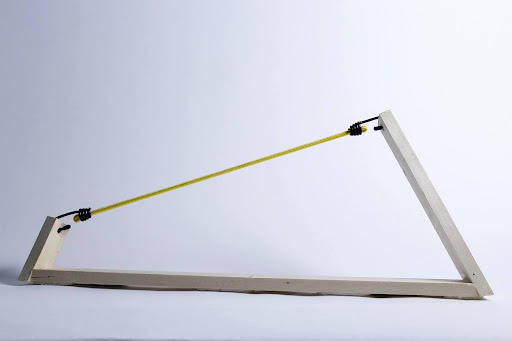
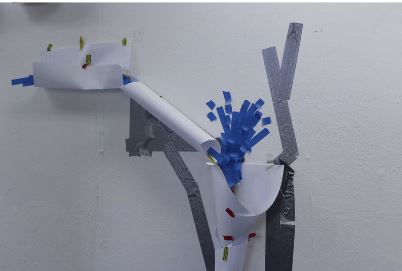
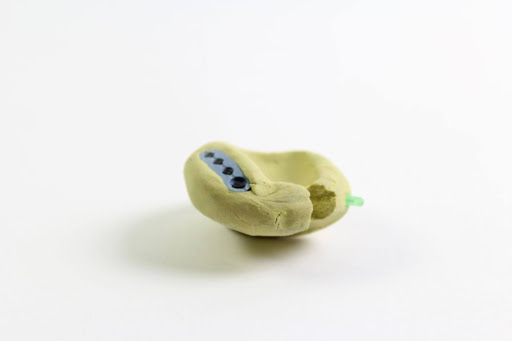
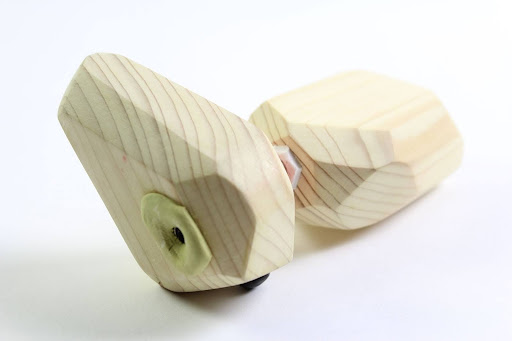
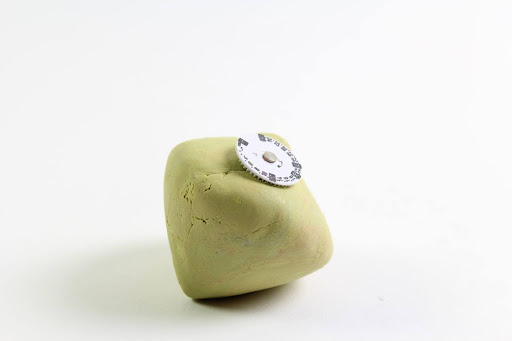
I still find this relationship between functionality and artistic expression a very compelling area of exploration in my practice, and would consider my current choice of websites as medium to be an expression of that same interest in subverting the intended functions of tools.
Installations
It was in 2020 that my practice shifted into being more digital. From late 2019 into 2021 I was engaged with Huddersfield Contemporary Music Festival’s Young Curator’s Programme ↗, and through this engagement I was supported in creating two installation works: Human Touch (2020) and Entity (2021).
As a result of the pandemic changing the scope of the 2020 festival, and thanks to the flexibility of my mentors at HCMF, I was able to pivot significantly from the intended activity of the programme (curating and organising a concert) and instead develop an artwork to be included in the 2020 festival.
Human Touch (2020)
https://www.charlotteroe.space/projects/humantouchAs a response to the fact that the 2020 festival was due to be completely online, I decided to investigate creating a website to contain my installation. This was the first time I had ever attempted to ‘code’ something, and also the first time I had made a sound-based work, which, again, was a decision that I had made based on the context it was being developed for (an experimental and new music festival).
Human Touch is a simple static web page containing a series of embedded mp3 files. Each is a short recording of some kind of tactile interaction with a found object or material. The intention is that the user of the page can turn these on and off, while adjusting the volume of each, to build up, what I referred to at the time as, a ‘sound sculpture’. I didn’t realise until after I’d formed my concrete research aims, but this is in fact the first example of a sound-making website as performance or composition tool that I’ve made.
Entity (2021)
https://www.charlotteroe.space/projects/entityI was invited to create another work for the 2021 festival, which was to be in person. By this time I had become very interested in creative coding and web development. I was working full time as an apprentice software developer and had received a Developing Your Creative Practice ↗ grant from Arts Council England to use to explore ways in which I could incorporate coding and creative software into my art practice. I had also been working with the Huddersfield sound art and experimental music collective ame (art music experiment) C.I.C ↗, helping out with organising concerts and exhibitions, and was becoming increasingly interested in working with sound. My next installation reflects this deeper immersion into both sound and digital practice.
Entity is a musical composition presented with a visual element to comprise an installation work. I put together the track through a process of data sonification. Using a python script and the Twitter (now X) API, I ‘scraped’ a year's worth of tweets posted between March 2020 and March 2021 from within the UK. I read every tweet and assigned it a category based on the main emotion being expressed, with notes recorded on any secondary emotions I found (I later learned that in statistics this is called a ‘sentiment analysis’ (IBM, n.d.), though I don’t know how often they are done manually like this). There was a process of mapping those categories and notes to different kinds of sounds in the composition. The visual element was a spinning graph of the track’s amplitude to be projected alongside its playback. I coded this with the p5.js JavaScript library.
My artistic goal with Entity was to explore a notion of the ‘flatness’ of online experience, and to propose sound as a method to give a sense of texture back to the dataset of tweets I’d collected. In this way I could consider Entity my first sound work in which I was making some kind of comment on the experience of using the web, something that I have sought to continue in this MA by research.
The notion of undoing the ‘flatness’ of the web presents itself again in the works in this portfolio, particularly with Clock, with its automated shifting interface moving independently from user action, and with TAB, where the performative focus is the building up of layers, placing instances of the tool on top of one another to give shape to the overall sound (see Project: Clock, and Project: TAB).
Live Coding
As part of my exploration into the various fields connected with creative coding, sound art, and experimental music, I inevitably found live coding. I had been trying to think of ways in which I could start to make music, and in particular musical performance (as opposed to sound installation), a part of my practice. I was somewhat intimidated by the idea of playing a musical instrument (something to this day I haven’t ever managed to become particularly skilled at), and was a little bit overwhelmed by the vast array of analogue electronic music equipment I had encountered so far. My comparative level of comfort with writing code led me to try out live coding as a medium through which I could start performing music.
My engagement with live coding was relatively short lived. I learnt to use Gibber ↗ (Roberts et al., 2016), a beginner friendly live coding language with a helpful online interface that means you can avoid having to set up an audio engine. Once I had gotten to grips with that, I ‘graduated’ to TidalCycles ↗ (McLean, Fanfani and Harlizius-Klück, 2018), which felt a bit more technical and involved, requiring me to install SuperCollider ↗ and Haskell ↗ on my machine and to go through the technical process of getting the three things to work together.
Rather than getting deeper into live coding, my interests diverted to what would become the basis of this research project. However, as discussed in detail in Context: Live Coding, I do still situate my practice as one that is heavily influenced by and in conversation with live coding.
Web Development
As is the case for most artists, running alongside my creative practice I also have a day job. For the last four years or so, following the aforementioned software development apprenticeship, that day job has been web development. Working as a freelancer I have designed and built websites for many clients, as well as making or contributing to more complex ‘web apps’ professionally. This has given me a degree of experience with web development technologies that, arguably, could amount to ‘tacit knowledge’ (Green, 2011) of those technologies or of web development as a process.
It is also undoubtedly a factor in why I have chosen the web as my medium and my subject. I spend more time than most dealing with the web as both a creator and consumer of its content, and as a result have a personal list of perspectives, opinions, and frustrations on how the web is, and could or should be. I think it is this combination of ‘tacit knowledge’ of a technology and a substantial critical perspective on that technology that have attempted to effectively combine to build a creative critical technical practice.